PROJECTS
Two places, one practice
Baraka’s work moves between two places: grassroots music education in Tanzania, and community arts programmes for young people in Finland. The thread running through all of it is simple — East African musical heritage, carried forward in contemporary settings, with performance, teaching and cultural documentation treated as one practice rather than three.
Baraka’s work with the East Africa Global Music Campus in Tanzania shaped both how he plays and how he teaches. Documenting regional music, performing it and passing it on are all part of the same job there — and that grounding in living tradition still runs through everything he composes, arranges and produces.
In 2023 he moved to Helsinki to study in the Global Music Programme at Sibelius Academy, first for his Bachelor’s and now his Master’s. Working alongside musicians from all over the world has widened what he hears and what he reaches for.
He has performed and collaborated with a wide range of Tanzanian and international artists, at platforms and festivals including the Jahazi Literary & Jazz Festival, Sauti za Busara, the Zanzibar International Film Festival (ZIFF), Etno-Espa (Finland), Global Club Nights at Caisa Cultural Centre and Vuotalo in Helsinki, and the Global Festival and Spring Festival at the Sibelius Academy Global Music Programme.
Baraka co-founded Action Music Tanzania (AMTZ), also known as Action Music Academy — a place where emerging Tanzanian musicians could learn, rehearse and perform. He was never only running it from a desk. He was in the room: at rehearsals, in coaching sessions, on stage. What mattered most to him was building somewhere young artists could take their own musical heritage seriously and still push it somewhere new. Tradition and invention were never treated as opposites there. Students learned both, and learned that the two belong together.
Baraka and the East Africa Global Music Campus
As co-founder of Action Music Academy (AMA), Baraka has been part of the Global Music Campus from its earliest days — both in running it and in teaching. Through AMTZ/AMA’s role as a partner in the wider network, his work serves the project’s central aim: a music education that genuinely fits the region, and that helps musicians perform, read, write, document and pass on East African traditions.
The Campus was shaped by what musicians in the region said they needed. Chief among it: a way to slow the loss of cultural heritage, and real skills in notation, recording, documentation and curriculum-building. Baraka’s work sits right there — teaching, helping the organisation stand on its own feet, and making sure local musical knowledge gets written down, taught well, and treated as a profession rather than a pastime.
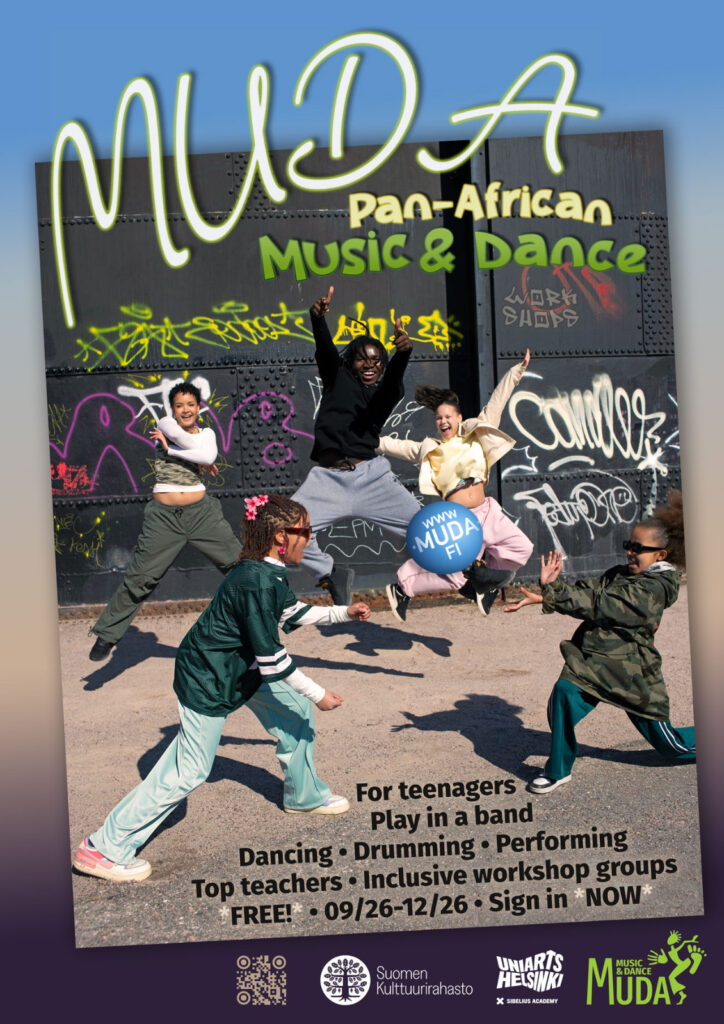
In Helsinki, Baraka leads the MUDA (Music & Dance) Project — the same teaching he developed in Tanzania, now with Finnish teenagers. The work takes traditional and contemporary African music and dance together: movement, rhythm training, ensemble playing, and building performances the group can call their own. Nothing is kept in a separate box. Dance isn’t split off from music, and tradition isn’t split off from what’s happening now. Young people learn African artistic practice the way it is actually lived — with their bodies, in a room full of other people. The project is supported by the Finnish Cultural Foundation.
What ties it all together
From co-founding Action Music Academy in Tanzania to leading the MUDA Project in Finland, the work has stayed the same even as the rooms changed. The piano is a storyteller. Heritage is something living that you build with, not something you put behind glass. And music education is community work — you teach because a community needs its music kept alive and moving.
Taken together, these projects say one thing: East African musical languages travel well. They can be documented, taught and grown inside contemporary ensembles — from a campus in Tanzania to a rehearsal room in Helsinki.